Evil
If you read my last post: I survived! That's all I want to say for now. Back to your regularly scheduled programming…
I recently watched the docuseries called Keep Sweet Pray and Obey. It chronicles the atrocities committed primarily by men in the FLDS (fundamentalist later day saints) movement. They were (still are, I think) a polygamist religion/cult that operated near the border of Utah and Arizona. It's a truly horrifying story. I couldn't help but weep when I listened to the stories of the women who escaped and slowly worked up the courage to work with law enforcement.
The first couple episodes hit me so emotionally hard I found myself tearing the white t-shirt I was wearing clean off my chest. It felt like the only thing I could do as I watched in horror.
It's really hard to watch something like that without considering the idea of evil. What is evil? How do we combat it? Is there any hope?
These are the questions I'm exploring cause I'm pretty fucking pissed off. I'm going to rewind and tell my own journey with evil from the last ten years. Stick with me cause it's a winding road.
Let's start with the word evil. I really dislike the word. It carries a ton of baggage from my Christian upbringing. When I think of evil I immediately think of satan, the devil, and demons. As I got older, and remained in the Christian church, I began to actually believe that evil spirits were real. I started to personally encounter them. Sometimes I'd wake up in the middle of the night and feel a heavy darkness. The kind of darkness that makes you sweat profusely, sends waves of chills down your spine, and makes you want to disappear under the covers and beg for safety.
I learned about something called "deliverance ministry" within the Christian tradition. It was a new idea for me but resonated deeply at that time. There was a guy who preached a series at our church about facing the demonic. He said that the spiritual realm operates primarily based on authority. He said that as followers of Jesus we've been given authority over the demonic and all we need to do is lean into our authority to cast away demons. He said that you needed nothing more than to tell them directly to leave and they'd obey.
Around that time I started waking up in the night with restless feet. I would flail around in bed for a while until I was worried I'd wake up my wife. Eventually I'd migrate to the couch in our living room where I could really flail and eventually fall asleep. Sometimes I'd get a shiver down my spine while in our living room. I started testing out using my own authority.
I tried on the idea of asking the Holy Spirit (essentially synonymous with God for most Christians) for the name of the demon so I could call it out directly. Sometimes a name would pop into my head that sometimes seemed silly. I went with it. I'd say the name out loud and tell it to leave. To my astonishment it actually worked. I could sense that some presence had left.
I thought I had discovered some secret to the universe that made me special. I was wrong but we'll get to that shortly.
As I continued to gain confidence facing these evil spirits so too grew a subtle hubris. I started to believe I had a formula to deal with evil that could be applied anywhere. I had a friend describe his encounter with a really dark feeling. I jumped in immediately and told him what he needed to do to get rid of it. It killed our conversation because it was pretty clear he didn't need someone to give him the formula for fixing evil presences. That was the first crack in my theory of evil spirits.
Then I read the book People of the Lie by M. Scott Peck, a psychiatrist and Christian. It was phenomenal and harrowing to consider the extent to which evil pervades the world. One of the main themes of the book is that evil is present whenever there is an avoidance of truth. He makes a strong case that most "demonic" symptoms are actually mental health issues. At first I didn't entirely believe him but it started opening up a door for me.
Around that time I started reading some of Carl Jung's work. He introduced me to the concept of "the shadow." Basically Jung said that all of us carry a shadow side that must be explored and faced with courage otherwise we'll be unconsciously ruled by it. He taught that our shadows are parts of ourselves that are exiled to the far reaches of our minds when we faced situations that overwhelmed us. While they remain in the shadow they begin to exert influence over us because they're trying to get our attention. He claims that we all carry a shadow side whether we acknowledge it or not.
Additionally I began to learn about IFS (internal family systems) through Richard Swartz's book titled No Bad Parts. That book blew my mind. In addition to introducing me to the concept of systems thinking (which is super eye-opening), it was the first time anyone had clearly said that there's nothing inside of us that we ultimately need to be afraid of. This was in stark contrast to my rigid belief that I was fundamentally sin at my core. He claimed that even the most ugly parts of us are not by nature bad. They are misunderstood and desperate to be properly witnessed and known. Yes, they really can be ugly as fuck but they can't be healed unless they are really faced with deep curiosity and kindness.
It was at that point the Christian idea of sin started to blow up for me. For a while I had toss aside the idea of sin entirely. I was deeply tired of everyone telling me I was fundamentally a piece of shit and I needed saving from my dirtiness. Let me tell you, that does a fucking number on a person's psyche. And salvation really didn't feel like salvation. I started really thinking, "how is this shit good news? We're mostly just surviving and swathes of Christians carry hidden addictions and are generally not nice people."
That got me to rethink these "evil spirit" feelings I was having. Perhaps they didn't actually want to be cast out. I started experimenting with giving them permission to remain and actually trying to converse with them. That was a deeply terrifying concept for me at the time. It's really hard to be taught your whole life that if you messed around with "evil spirits" you'd be utterly fucked and essentially damned to hell (but not really cause Jesus covered your sins but you might need to "invite him into your heart" again cause maybe you were't actually genuine the first 10 times you did it before, just to be safe).
I found that as I began to press in to them they weren't actually as scary as I thought. Nothing terrifying popped out and I actually was strong enough to look at them. I remember one time looking at myself in the mirror in the dark and noticing my silhouette staring back at me. I had this distinct impression that it was, indeed, some part of me that's observing and influencing me from some other part of my mind. It kinda felt fun to start looking into the dark.
I'm getting tired of telling this story in such detail. Let's cut to the chase. Yes, what I thought were evil spirits were my "shadow." And yes they carry a hidden strength that I'm beginning to experience. And yes they really are scary as fuck. And yes sometimes you need to really go outside your comfort zone and "die" in order to actually embrace them.
I believe this is where traditionally humans have used initiatory experiences. They needed powerful rituals that brought people into contact with their full selves, especially the dark parts.
So now I'm coming full circle back to evil. I think it's a poor word because it gives the impression that it's something "out there" when in fact evil is something we all carry. It's not ultimately what we are at our core, but we all carry it like a crust (aka shame) that forms around a golden white center. I believe that nothing can touch that core. I believe that humans are fundamentally good. Created in the image of God as Christians too infrequently talk about.
So what then is evil? Is it nothing more than the collective result of our individual mental illnesses?
I don't think so. I believe it operates with its own kind of coordinated intelligence. But I think dignifying it with a human-sounding name gives it too much power. It makes it too scary to face, too weird to be examined. It distorts it into something that can't be studied or measured. And I strongly believe it needs to be studied and eradicated.
It's really hard not to look around at the world and come to the hypothesis that something is trying to destroy us.
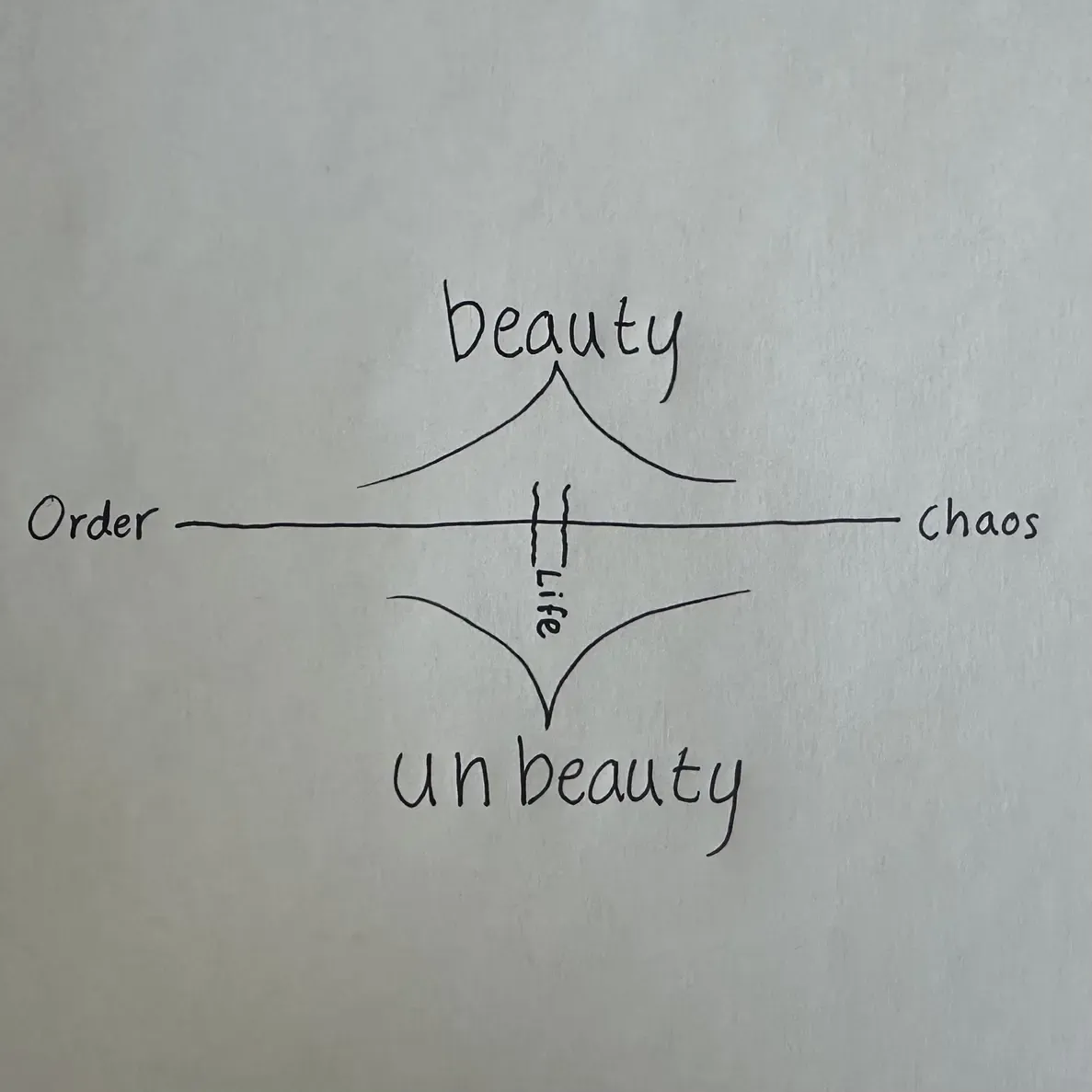
I'd like to call it "unbeauty." There seems to be some kind of dismantling intelligence that emerges within systems. Systems being widely applicable. A human is a system. A company is a system. A government is a system. A culture is a system. Everything is systems of systems of systems.
I think it's like an intelligent disease that infects systems and it somehow feeds on the destruction of beautiful things. I think it's why minorities and women are so often targeted by it. It most often wields power, shame, authority, and deception to accomplish its disintegrating intent. It works most powerfully when unobserved.
I also resonate with the framing around beauty. Beauty is hard to define, but we all feel it. The world, and its balanced ecosystems, is beautiful. People are beautiful. Real compassion and care are beautiful.
I consider God to be the ultimate beauty maker who sits in direct opposition to the dismantling force of unbeauty.
The really interesting thing to me is that beauty and unbeauty sit outside the spectrum of order and chaos. I watched a brilliant documentary by neuroscientist Sam Harris called Psychedelics Don't Distort Reality — They Reveal How Your Brain Constructs It. In it he proposes a model for life that says that life exists in the delicate balance between order and chaos. Too much order and systems break down. Too much chaos and they also break down.
That was fascinating to me because I've always thought of chaos as inherently "bad." But I don't think that's the case. Life is a beautiful phenomena that emerges from the blending of the two, and it's a delicate balancing act.
The key insight for me was that both beauty (God) and unbeauty can intelligently utilize chaos and order to accomplish their respective goals. People who are most infected with unbeauty seem to oscillate heavily between order and chaos. One minute they're telling you about the love of Jesus, the next they're pissed off at you because you said something that triggered them.
Beauty suffused people seem to have a smaller baseline oscillation between order and chaos. They fear neither and are unperturbed by small movements in both directions. They are fully alive.
Overall I think unbeauty (evil) deserves a lot more attention than it gets. And it deserves a lot less anthropomorphizing than we give it.
And the first place every serious "evil scientist" must start is within themselves.